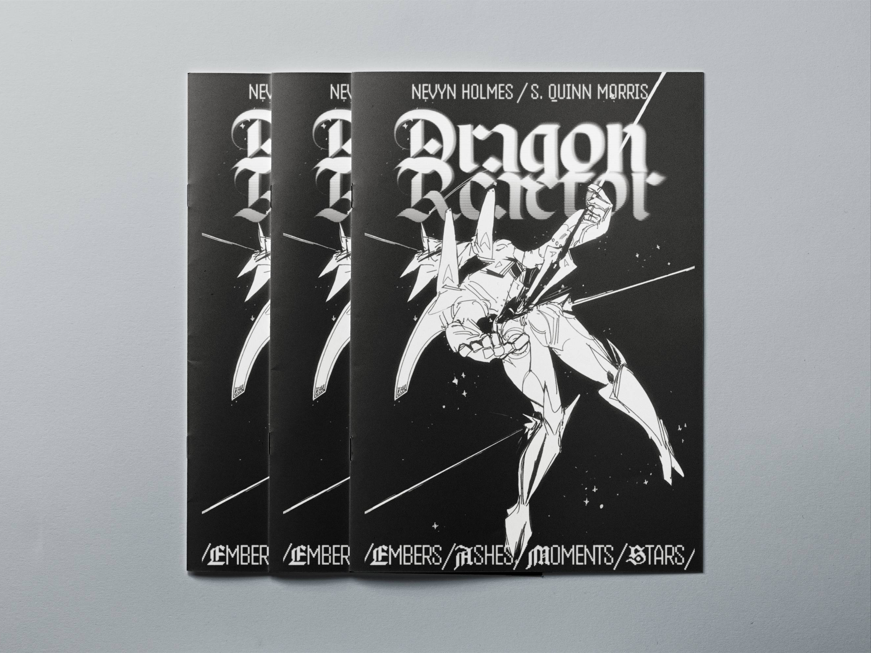
Dragon Reactor: Embers, Ashes, Moments, Stars
by Nevyn Holmes and S. Quinn Morris
The Pitch
You are Pilots, at the helm of a Dragon - a giant, powerful mech - fighting in a war that seems endless and with doom looming over the horizon and your heads, while trying to remain human and connected to those who anchor you. One of you is the Poet, the person in charge of facilitating the world around the Pilots, the push and pull of the horrors of the forever war, the schemes of the factions in play and Rivals in battle - and the small moments of reprieve in between.
The Experience, in Brief
- I ran the demo as the game was funding, and it got a hold on me enough to pledge to access the in-development documents.
- I have since run three more games, one with steampunk retrotech dinosaur fossil frames, one with crystal powered magitech, one with more traditional mechs using semi-sentient nanotech coating.
- The art by Emma Harvey (and cover by Charlotte Laskowski) has done more heavy lifting in pushing this game than my pitch to tables.
- Props to JAM and Luna P. for the layout work on the two versions of the game (respectively the Demo and the final game), it made looking up info during games incredibly intuitive while never losing any of the game's poetic flavour.
- If you want to experience the kind of stories it can tell, I recommend the One Shot podcast episodes, from which I unabashedly stole the premise and opening narration for two games I ran.
The Really Good Bit
The action resolution mechanic is very good, baking complications into the degrees of success, and you can find a variant of the same in Nova's previous game You're in Space and Everything's Fucked. The shared world-building that reinforces itself after every battle is also excellent, and enables full investment in the characters and the world they inhabit.
But then there's the way in which the game sets up downtime actions, and the scenes that happen between conflicts, and that's what made me the most excited about the game: Countdown.
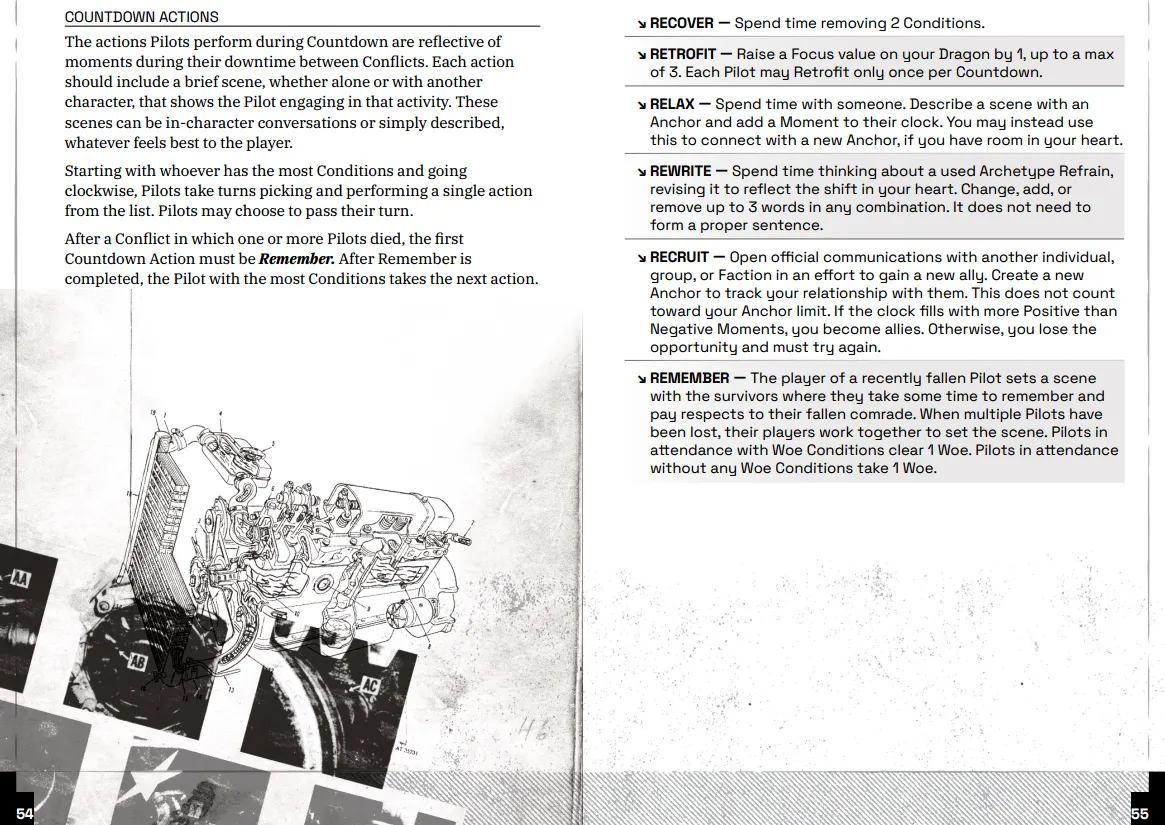
This was an aspect of the game that wasn't present in the demo, but that was calling to me almost immediately once teased, to the point - as I said above - that I pledged at a higher tier just to see how it was going to work out.
In brief: at the end of each Conflict, after you deal with the Aftermath (which includes naming the conflict, usually a twisted irony of a name, as these things go), you get a downtime phase, called Countdown. You build a shared dice pool, based on how many pilots survived, on whether you won or lost, on how many dice you set aside during the conflict itself, and you roll for each of a selection of actions going around the table. Actions include fixing Dragons, healing up, roleplay scenes with your anchors, bringing new important NPCs into the narrative, or changing something fundamental about your pilot.
But, if any pilot died during the conflict you just completed, your first action must be a funeral, a memorial, a wake, a ceremony, something to Remember your fallen friends by. You must roll the dice pool, removing all dice that show ones and twos from the pool, and hope that everyone gets a turn to roll before you run out of dice - or war comes knocking, and the next Conflict begins, catching you on the backfoot.
The tragedy - the delicious tension of having a touching scene of everyone commemorating fallen pilots - of the next player spending time with a loved one, only for the dice pool to immediately be depleted and the entire metaphorical (and probably literal) base going on high alert as enemy suits and Dragons come into sight, and begin their retaliatory strike? It has, so far, happened to me twice out of three games,1 But that one moment of horrifying realisation that no one wins the forever war, that Tomino-influenced horrible grounding of what could easily become a narrative of heroic combat, that one instant of "oh shit, we're not ready"? That is where Holmes and Morris have truly triumphed in designing their terrifying storytelling machine.
This is War's time, and you're just borrowing it.
If you want to build your world, and then fight for it; if you want giant robots and small moments of humanity; if you want to wield the power of myth and war, and realise how hard it is to hold back - get in the robot, and sing.
I am about to conclude that final Conflict in a week from publishing this. It's not looking good.↩