Was it all worth it? A narrative review of Harvest
game by Luke Jordan, review by Zhen, João, Timo, alex v
Trim their heads and put-‘em-on-ya bed,
Slash them ‘twoon? Stab or strike?,
Put them to-ge-ther on the pike!
Harvest is the rolling hills and sheer cliffs, it’s the gentle breeze and the sea in storm, it’s the warm smile and the jagged blade hidden behind it. It’s beauty and it’s death, and it’s you and all you’d be willing to give for that life.
And at every turn, Harvest is the questions echoing down through the generations: ‘Whose blood must be spilled to feed the land?’ and ‘Whose hand will hold the knife?’
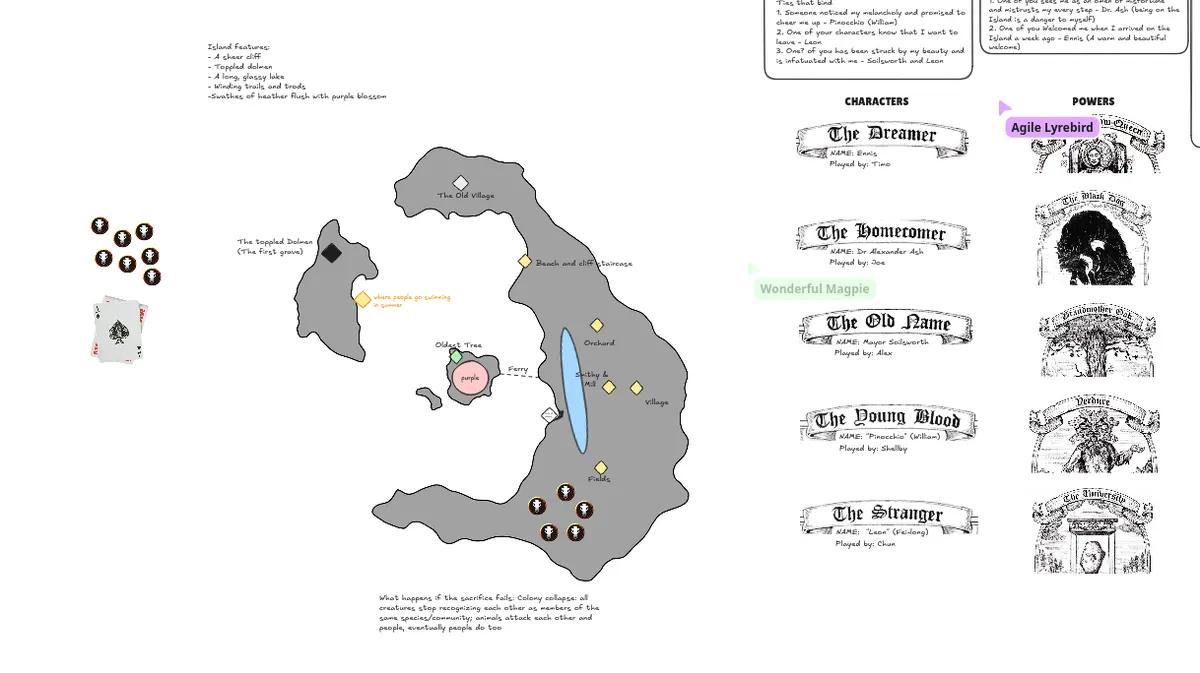
Chun, as “Leon”/Fei-long, the Stranger
Harvest is to experience horror from the lens of the peaceful, and a space to learn new styles of play.
In an inversion to the designer: I was born in the country Harvest is meant to represent, but I am not native to it. A lightning-in-a-bottle moment for me was believing this game was set on the cusp of the 20th century.2 This was during the time of the Meiji Restoration, when the Japanese government funded a Naval exchange programme with the British, which allowed Japanese Naval officers to visit the UK and train under the British Navy.3
The circumstances that brought East Asian folks to Britain is what inspired me to play “Leon” the Stranger. A Naval private from a strict upbringing, he was visiting his cousin (Alex’s Mayor Soilsworth) for the first time. In my mind, he was using the excuse of ‘making his family proud’ to get away from them. The playbook moves sparked numerous ideas to highlight and heighten this conflict. I could take tokens by criticising the island, listening in on private conversations, or stealing an important resource…conversely, the moves allowing me to return tokens gave me (“Leon” and the player) the choice to fall in love with the island. Boy howdy what “love” it was: this man’s first ever crush was Timo’s Ennis. I was indulging in a conflict sandwich that the game taught me how to assemble!
I put a conversation of Bleed right in the front and centre of this table and I was glad this table was receptive to the choice I made. What made the choice so sharp was that while it added depth and horror, in no way did it interfere with the core experience. Act one was exploration and expressing the strangeness of… well, the Stranger. Act two was of “Leon” intensely studying the ritual, alienating himself from the community and family, refusing to accept the “truths” and the “fates” presented to him. "Leon” did everything in his power to rationalise and stop the ritual, knowing that horrors of the outside world were worse than this one. Act three: he pulled out his gun in an attempt to appeal to the common good of the people…and failed, the ritual turning into a mirror of rituals that happened in Fei-long’s home. As atonement, he threw away his old identity and decided to truly become “Leon” living the rest of his days on the island. If asked “Was it worth it?” he’ll say: “Ask me again at the next Harvest - I’ll be there”.
I am most practiced at running peaceful and grounded games. Harvest facilitated horror within peace, and crucially: all the choices I made supported my strengths, my weaknesses, and the choices of players around me. That’s the magic of Harvest and the stories it can tell.
João, as Dr Alexander Ash, the Homecomer
Harvest is coming back to the town you grew up in, it’s feeling nostalgia for your old haunts, but seeing them forever changed by time. It's knowing the world has changed you and feeling pity when others seem to have stayed the same, and it's seeing how wrong first impressions can be.
One of the roles of the Homecomer is contrasting the outside world with the Island, both as a way to show how paradisaical the Island is compared to the harsher wider world, but also how its customs can be suffocating and backwards. As Dr Ash I tried to channel some of the discussion people have had about “The Ones Who Walk Away from Omelas”, the idea that yes, this place is great, but there are other beautiful places in the wider world that are not sacrificing someone ritualistically in exchange for their prosperity, why must we be different? Is the Island and its people so fundamentally broken, that we can only be happy and safe by killing one of our own to appease some ancient god? I raged at Mayor Soilsworth for following her role with no resistance, and for bringing a poor outsider like Leon into the darker, mythical side of the Island, while also trying to push them all to choose deliberately whether they really wanted to follow along with the ritual.
The stories generated by a story game are a collaboration between the designers and the players: the designers must do the analysis, take multiple stories of a genre, figure out their structure, and break their characters down into their archetypes. The players do the synthesis, each one takes a different archetype, and reifies it into a full character; then they follow the constraints imposed by the rules, inspired by the stories’ structures, and they live a new story of the genre the designer analysed.
Harvest is a masterclass in this kind of story building, and this kind of RPG design, with an extremely evocative writing that sets the tone from page 1, playbooks that perfectly capture characters from any folk horror story you've come in contact with, clever moves that help you inhabit and act like them, and a beautiful three act structure to guide the play.
Timo, as Ennis, the Dreamer (whose hand held the knife)
Harvest feels like long evenings spent at my grandparents’ cabin. Evoking a time that never really existed. When life was simpler, neighbours were decent and the stars shone bright in the night sky. With its sprawling fields, lush orchards and sheer cliffs it captures a romantic vision of a rustic 18th century life (that a surprising amount of people yearn for and a distinct few try to sell us, as demonstrated by my partner sending me a reel about just this kind of life right as I’m writing this) right up until it takes an elegant step back and offers you a sleek knife to impale yourself on.
It does one brilliant thing (amongst a sea of other brilliant things) that I have grown more and more fond of over the years, as I play and run different kinds of games. Harvest lets the players create a place to fall in love with, protected from the banality and ugliness of the real world. Powered not by some magical spells of wizards or warlocks, but by the simple magic of song, oaths, blood and the land itself. Harkening to the fairy stories of old, the kinds that parents used to tell misbehaving children. Where danger lurked just beyond the veil. Not stories of heroic knights and beautiful princes, though there is heroism and beauty abound in Harvest, small scale as it is. A parent taking care of children, windswept hair and callused hands, taking as much as you need from the land and not as much as you can. A simpler life, peaceful. A place that nowadays exists mostly in cameras and editing software and not in the long hours and hard labour that living off the land and as part of the land brings. But it is a powerful fantasy nonetheless, far away from this capitalist hellscape we live in now. A life worth living, seeing your hard work pay off as something of tangible value instead of numbers in a spreadsheet. And who can blame someone for wanting to live in it, when whenever you look out the window you see gray skies and unhappy people.
And once you crafted this pastiche of a pastoral paradise, held this fantasy in your hands, saw it slowly slipping through your fingers like grains of sand, Harvest leans in and whispers into your ear: “Is this what you want? How much will you give to preserve this? Is it worth a life? What about the life of someone you own? Your own family? What about your life?” and with a knowing smile it hands you a knife slick with blood, and the full weight of guilt and understanding of the generations before you that all made their choice, and you see it in front of you. The obvious choice. The one that you’d never want to make, but you know you must.
What most surprised me about my time with Harvest isn’t what it made me do, but how hard I fell for it. Despite our very short stay with the Island and its inhabitants I miss it more than many other games I played that lasted much longer. Usually I fall in love with characters in retrospect, reflecting on all we have experienced together, but Harvest has made me fall in love with Ennis by the end of the first session. If there’s only one thing I could convey as my glowing recommendation of the game, it’s this.
Alex, as Mayor Soilsworth, the Old Name (whose blood was spilled to feed the land)
Harvest is, ultimately, a game about choices. I hadn't chosen, hadn't even thought of a first name for my character, until her final moment. She was born in my mind as an intentional pushback against a general temptation to make a bleak, darker character for a horror narrative. Through play, through the choices I felt compelled to make she became someone who really cared for the Island we created, its people, its history, her attempt at a family of sorts in William,4 her newly discovered old family in Leon, her newfound crush in Ennis. She trembled and cried when Ennis was revealed as the knife-wielder, she felt true, palpable anger when the community turned on each other as the Omens kept being revealed, putting people - children, above all - in danger. She knew what had to be done, and she knew Dr Ash (a foil to her in almost every interaction) and Leon were right, at different junctures: she was defined entirely by her family name, she had never had a choice in any of this. Even her title wasn't granted by an election, just inherited. All of her sense of obligation, her self-imposed duties, the identity placed upon her, including the old power behind her family, Grandmother Oak - she chose none of it, and accepted it all as a given.
Leon was the outside world coming in, showing that things could be different. Dr Ash was painful proof that maybe they could not, and the Island will bring you back eventually. Ennis was the Island itself, its wild, terrifying beauty, and the tender cruelty needed to maintain it all. William was angry ambition, and a burning desire to change without the means to do so.
I could not have been more pleased when Soilsworth was revealed to be the sacrifice. The final act of our little play brought us all back to the ruins of the old village, to Grandmother Oak, to the community gathering around Ennis and Soilsworth, in a ritual that was almost a wedding. A knife cutting into a kiss, almost interrupted by outside-world reason (in Leon’s attempt to step in), and brought to conclusion by Soilsworth’s own hands.
Her name was Ellen. She was of the Island, always had been, never by her own choice; in her final moment, as she pulled Ennis’ hand holding the knife into her stomach, the choice was finally hers.
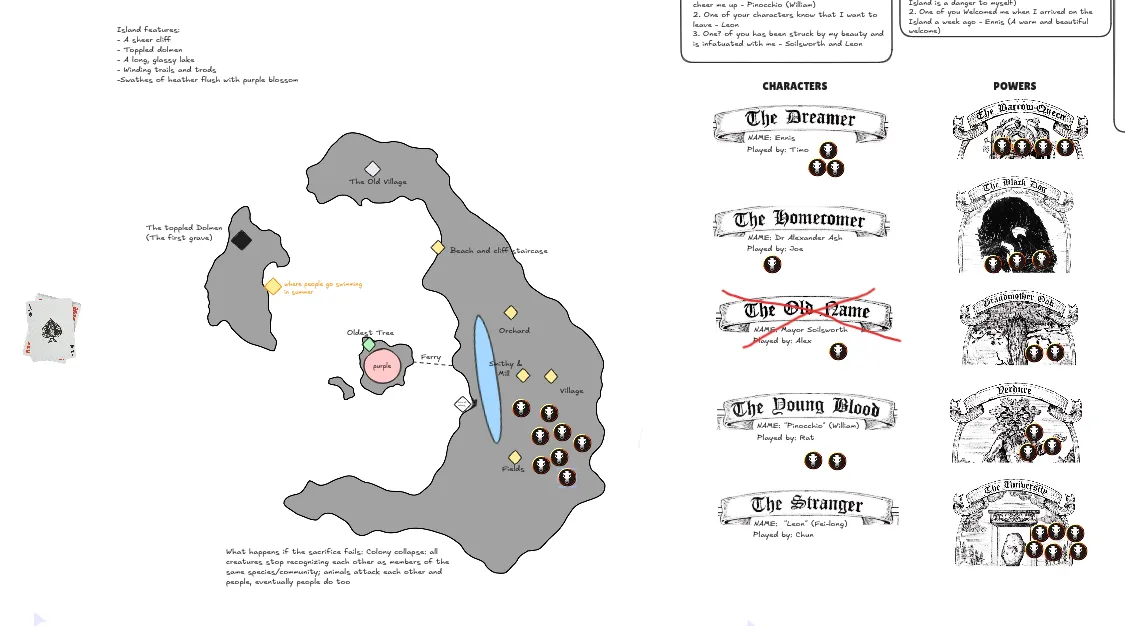
Harvest is a game in which players exchange and spend tokens to push an island community towards a seemingly inevitable sacrifice, in order to maintain the idyll of the island itself. It's published by Possum Creek Games, designed by Luke Jordan of Wildwood Games and uses the Belonging Outside Belonging system created by Avery Alder and Benjamin Rosenbaum.
Fictional, made during our game.↩
Harvest is actually set “around the eighteenth century”, so less than a century earlier than the initial exchange in 1870 when British Naval officer Lieutenant Albert G. S. Hawes visited Japan. While the attempt to make this game of Harvest historically poignant missed the mark, it did not detract from the impact and poignance of the experience.↩
Abel, S. (2021) The beginning of the Imperial Japanese Navy, Drachinifel’s Digital Drydock. Available at: https://www.drachinifel.co.uk/articles/startoftheijn (Accessed: 16 September 2026).↩
Our fifth player - Rat, as William/Pinocchio, the Young Blood, whose power was Verdure - was unable to commit to writing this piece, but was very much present during the game.↩