Whittling Down
Or, four games that make you more by making you less.1
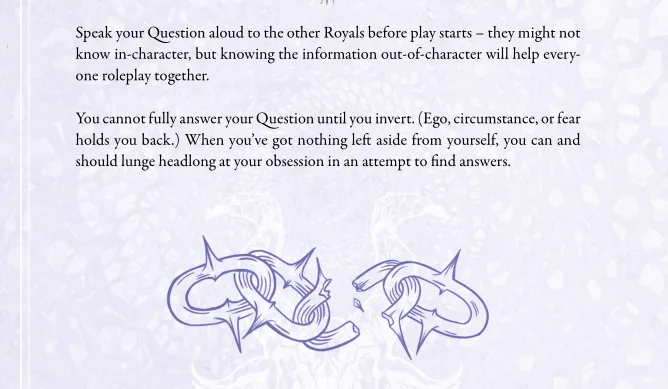
In Royal Blood, you wager Facets - aspects of yourself, some grounded, some entirely the opposite - to test Fate Herself and tip her hand in your favour; you will eventually and inevitably mark, then lose, said Facets, leaving you with one single thing to wager: yourself, inverted, and the question that drives you (which you can only answer in that moment of inversion, never before).
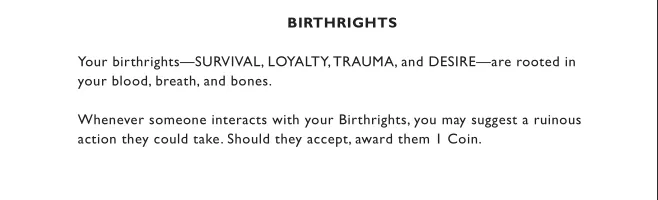
In Heaven in the Dust, you each oversee four Birthrights - macro thematic concepts, like EXCESS, TERROR, NECESSITY, LOYALTY - that can influence the story and reward other characters for leaning ruinously into them; at the end of each session, you erase one, eventually and inevitably leaving you with just the one theme ('a starker, harsher truth', p. 11) driving your story.
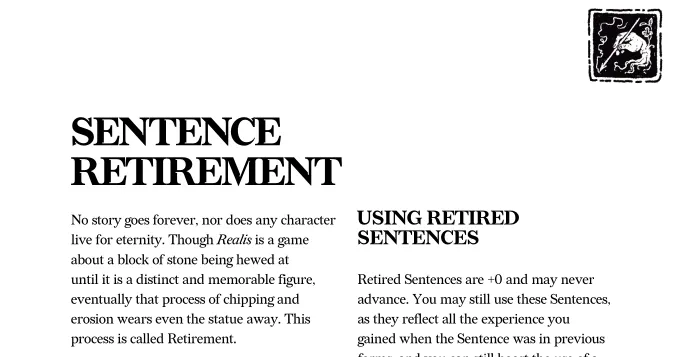
In Realis, you keep chiselling at your character's Sentences as you realise them, moving their meaning from generic to more specific each time; as the story progresses towards an ending, you will eventually and inevitably retire each Sentence, leaving you with something that you used to be rather than something that you always are.2
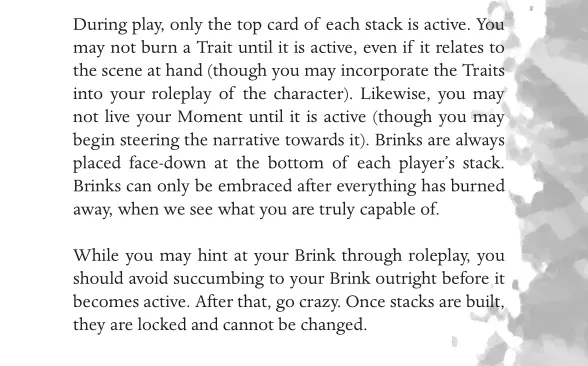
In Ten Candles, you have a stack of two Traits, a Moment, and a hidden Brink. As you progress through the dark and after a scene ends, you collectively speak truths, one per still lit candle; the main on, ritualistically spoken with each scene, is THESE THINGS ARE TRUE. THE WORLD IS DARK. AND WE ARE ALIVE. As the candles darken, as the truths spoken diminish, as your dice pool shrinks, as your literally burn your Traits and Moments, you will eventually and inevitably discover your Brink and your character's end - and one final truth about the world: THESE THINGS ARE TRUE. THE WORLD IS DARK.
Bonus entry, thanks to Sera: Disparateum, and its Ritual of Reshaping, especially that final step.
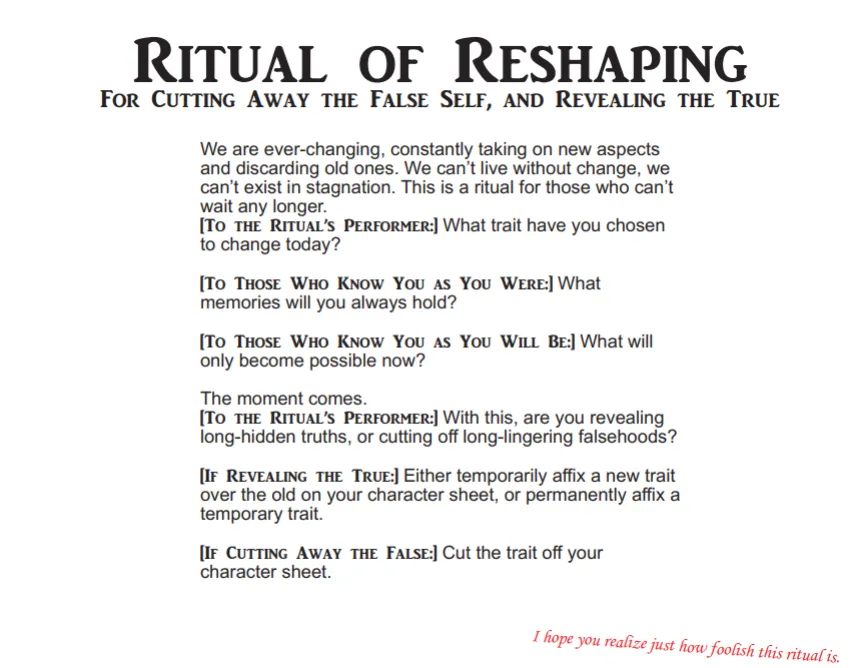
In each of these games, your actions do not add abilities or skills or levels to your character, you do not accrue more aspects as you develop your story; you lose them. You refine what makes you You, but it only happens - it can only happen - through play. You can't pre-set or pre-select the direction your story goes in until you play through it.
Play to find out what a story takes from you,3 and what is left once it's done taking.
I don't have anything else to say about this, beyond: I like it. This mode of storytelling is fun, and I want to see more of it. If there is more out there, I will attempt to find it.
Featured image: “whittled it down to correct diameter, using a knife made by my grandfather for my dad!” by Dale Simonson, CC BY-SA 2.0
Games are in constant conversation with each other, even when they don't know it, and it's silly to pretend they're not. This is also inspired by a comment I made in the Quinns Quest Discord server, and Seraphina's manifesto.↩
Realis also takes a powerful step with its rules on how to end a game, i.e. 'write one final Sentence summarizing who your character was, as in “Adarak was always a committed friend.”' (p. 92)↩
'Stories are the wildest things of all, the monster rumbled. Stories chase and bite and hunt.' (A Monster Calls, P. Ness, S. Dowd, J. Kay, p. 45)↩