Cards as Places
Or, How sometimes a house of cards is actually a whole city.
A few months ago, I was considering how to approach preparing a physical space for an abstraction of a character's story. Specifically, I was trying to think about how my blossomed Hunter, Kemin Scrivener, would lay out the Hollow he'd become the Lord of. I had the ideas for what was in the various areas, but not much more. I wrote them down on index cards, and placed them on the floor of my flat. They became an almost literal blueprint, the locations telling a (mostly) complete story.
I was in the throes of what I have come to affectionately call "work hell" for most of August, September, October. Even in that delirium, I was still able to run a couple of games. Heart, specifically for the purpose of this point. I was planning a session of I'm sorry did you say street magic too, which didn't actually happen. In preparing for those games, I was reminded that writing things down and connecting them is a way to get them out of head and into more tangible ideas. I'm sorry did you say street magic specifically uses index cards as ways to create your table's city, abstracting locations into what they mean to people who visit them. "The city is defined not through walls, but through words."1
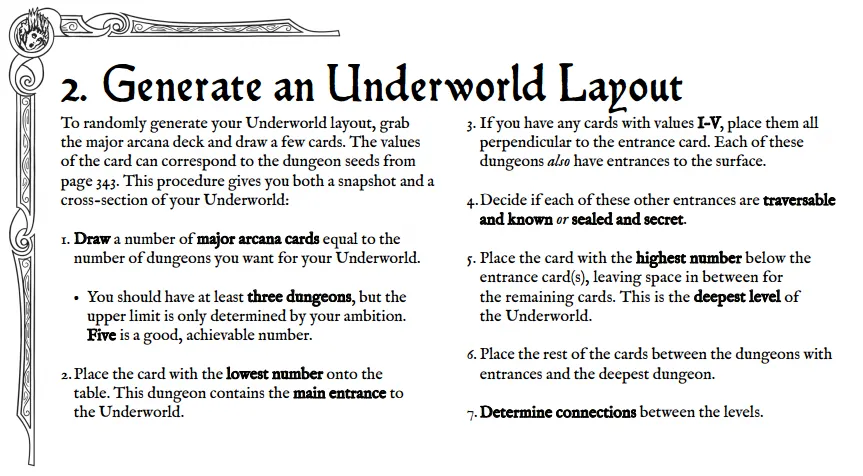
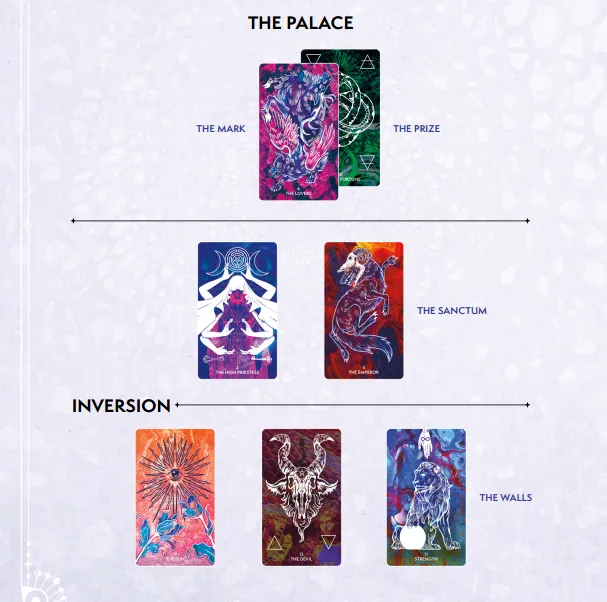
I recently played through a single session of His Majesty the Worm, and while I don't think I am a convert quite yet - I may never be - I do like the way that the book suggests and structures its City and Underworld creation procedure: for the former, you draw minor arcana from a tarot deck, and arrange them according to which suit is central to the spread - which becomes the sprawl; in the former, you draw major arcana from a tarot deck, and arrange them to form areas, connections, and entrances from the City to the Underworld.2
And finally, there's one of my favourite games of recent times, which I have mentioned previously on here too: Royal Blood. The game asks you - Fate Herself (GM) and Royals (players) alike - to create a spread of cards that represents the entirety of your heist. Each card, called an Icon, can be a Location, a Person, or an Object, and each of them has a Function. All of them together are also the City where your heist takes place. It forces you to ask and answer questions such as: how are the Hermit and the Chariot connected? and how is it the Lovers' fault? and most importantly, how can we use it to our advantage?
I was discussing these games a few weeks ago in the Quinns Quest Discord, and I realised that what I find most interesting about this type of game is how the connections between the cards - both in terms of connecting the spaces between them as physical locations, and the narrative connections and patterns that emerge from placing them in proximity of each other3 - are something that speak the loudest to my tapestry-weaving approach to storytelling: find the details, bring them together, make them fit a pattern if possible, and that's your plot.4 This is not limited to cards, but cards are a tangible representation of using the pieces the game gives you to make associations between how those same pieces are arranged on the canvas, or table. A way to help define the city of play by words, as it were.
With thanks to Sparky! who made a comment that started this whole thing: "By writing them down, you trap the soul of the idea in the paper, and they'll give you more in exchange for freedom." And to the game of Sorcery I just played, in some ways.
Featured image by Matthew Goeckner on Pexels
One could spend a worse evening than reading through the afterword of I'm sorry did you say street magic.↩
DIE RPG did this a year earlier, too, under the guise of Dr Gillen's Unpatented Tarot-Dungeon Generator, in a much more freeform manner: "As the players reach an unexplored area of the tarot map, flip the corresponding card. Use the details on the card in conjunction with the details of the players to inform the encounter. At the very least, it can suggest an environment. If you know a lot about tarot, use what you know. If you don’t, use your imagination." (DIE RPG, p. 177)↩
The House Edge, at least from the demo but very helpfully rendered on its crowdfunder page, very much fits in here. I have yet to play it however, and cannot speak to its execution yet. I am excited to.↩
If ever Seven-Part Pact comes up with a quiz to determine your wizard personality, I suspect I will be inevitably connected to the Sage.↩